

SEO for Small Businesses: The Complete 2026 Playbook to Getting Found on Google
Paid ads stop bringing customers the moment you pause your budget. Here is a practical, jargon-free SEO playbook to help your small business win Google's local pack, attract ready-to-buy leads, and turn your website into a compounding sales channel.
If you run a growing business in Egypt, the Gulf, or anywhere online, you already know how expensive paid acquisition has become. Instagram and Google Ads can generate clicks overnight, but the day you turn off your ad spend, your leads drop to zero.
Search Engine Optimization (SEO) solves a completely different problem. Done properly, it turns your website into a compounding asset that captures high-intent buyers—people actively typing your service into Google right now—month after month without paying for every click.
How Google Actually Ranks Small Businesses
Forget the technical myths. Every Google algorithm update boils down to one core question: is your page the clearest, fastest, and most trustworthy answer to what this person just searched?
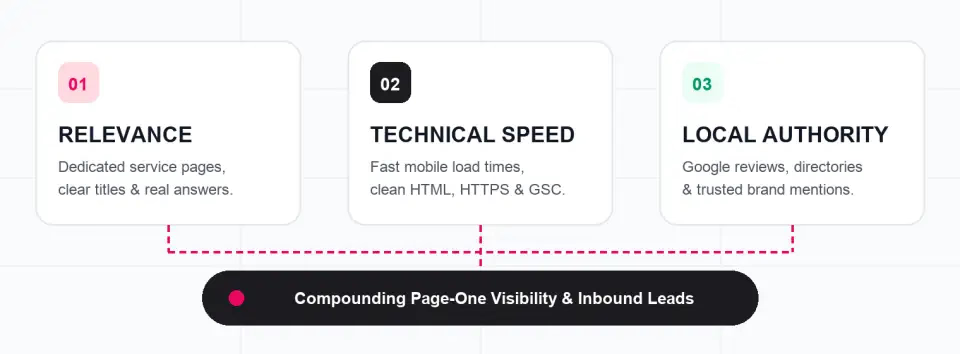
To decide who deserves the top spots, Google evaluates every small business website across three reinforcing pillars: Relevance (matching searcher intent), Technical Health (speed, crawlability, and mobile experience), and Authority (reviews, brand mentions, and real links).
Paid Ads vs. Local SEO vs. Organic Website SEO
Smart founders rarely treat ads and SEO as an either/or choice. Instead, use paid ads to validate offers quickly while building your SEO foundation to lower your customer acquisition cost over time. Here is how the three channels compare:
| Factor | Paid Ads (Meta / Google) | Local SEO (Map Pack) | Organic Website SEO |
|---|---|---|---|
| Time to First Leads | Days (immediate) | 2–8 weeks | 3–6 months |
| Ongoing Cost | High — stops when budget pauses | Very low (time + reviews) | Upfront site + content investment |
| Buyer Intent | Mixed (disruptive on social) | Very high ("near me" ready to call) | High (researching & comparing) |
| Best Used For | Launches, promos, fast testing | Clinics, studios, agencies, local shops | B2B services, e-commerce, regional scale |
| Long-Term Asset Value | None once spend stops | Strong local moat via reviews | Highest compounding equity |
Step 1: Win the Quickest Victory With Local SEO
If your customers visit your office, clinic, showroom, or hire you within a specific city—like Cairo, Alexandria, Riyadh, or Dubai—Local SEO delivers the fastest ROI in digital marketing. When someone searches for a local provider, Google displays the 3-business Map Pack right above regular websites.
Optimize Your Google Business Profile Like a Storefront
Lock in NAP consistency everywhere: Keep your exact business Name, Address, and Phone number identical across your website footer, Google Business Profile, Facebook, Instagram, and LinkedIn.
Choose surgical primary & secondary categories: Pick the narrowest primary category that matches your revenue driver (for example, Software Company instead of generic Consultant), then list each core service individually.
Upload authentic, real-world visuals: Genuine photos of your team, storefront, workspace, and finished client work consistently earn more clicks and direction requests than stock photography.
Build a repeatable review habit: Send a direct Google review link right after delivering a great result, and reply to every review within 48 hours. Mentioning the service naturally in your reply reinforces local relevance.
Step 2: Target the Exact Phrases Your Customers Search
The single biggest reason small businesses quit SEO is choosing the wrong battleground. Trying to rank for broad two-word phrases like "web design" or "accounting" pits your small site against billion-dollar directories and global publishers.
Instead, focus on high-intent long-tail keywords—specific 4-to-7-word phrases typed by someone holding a credit card or preparing to request a quote. Compare "coffee shop" with "specialty coffee roaster in Maadi," or "online store" with "custom e-commerce developer with Paymob integration."
Related Guide How Much Does a Business Website Cost? A Realistic Breakdown See realistic EGP pricing tiers and how technical SEO affects your website investment.Step 3: Nail On-Page SEO on Every Core Page
Once you map out your target keywords, assign one primary topic per page. Avoid stuffing five different services onto a single generic homepage—Google needs clear, dedicated pages to rank you for each offering. For example, separate pages for custom web development, UI/UX design, and e-commerce solutions each capture distinct buyer searches.
Your Essential On-Page Checklist
- Keyword-led meta title (50–60 characters): Put your primary keyword and location near the front so searchers immediately recognize relevance.
- Benefit-driven meta description (140–155 characters): Treat it like ad copy—state the outcome clearly to boost your click-through rate (CTR).
- Clean heading hierarchy: Use exactly one
H1per page, organize major topics with scannableH2s, and nest supporting details inH3s. - Short, readable URLs: Prefer
/services/web-developmentover cluttered strings like/page?id=482&ref=nav. - Intentional internal linking: Link related blog guides directly to your core service pages using natural descriptive anchor text—helping both visitors and Google's crawlers discover your highest-value pages.
Step 4: Fix the Technical Foundations That Quietly Kill Rankings
You can publish the smartest guide in your industry and still sit on page three if your site takes six seconds to load on a 4G smartphone connection. Google uses mobile-first indexing, meaning it judges your entire website primarily on how fast and usable it feels on a phone.
This is also where DIY templates often hit a ceiling. Heavy drag-and-drop themes load dozens of unused scripts on every visit. If you are deciding whether to stay on a builder or upgrade to a lean engineered stack, compare the trade-offs in our breakdown of custom websites vs. website builders.
"SEO isn't about tricking Google's algorithm. It's about making your website so fast, clear, and genuinely helpful that Google would look foolish recommending anyone else."
— Cairo Code Studio Engineering & Growth Team
Step 5: Publish High-Trust Content & Build Natural Authority
Small business owners often hear they need to publish four blog posts every week. That advice creates burnout and thin filler articles nobody reads. Instead, commit to one deeply useful piece per month built around real buying decisions:
- Transparent pricing breakdowns explaining what drives costs up or down in your industry.
- Honest side-by-side comparisons helping prospects pick the right approach for their budget and stage.
- Step-by-step checklists and playbooks that solve an immediate pain point before they even call you.
- Real local case studies demonstrating measurable before-and-after outcomes.
Pair that content with steady off-page trust: list your company in reputable local chambers and industry directories, co-publish guides with complementary non-competing businesses, and keep your site updated and secure year-round through structured website care and support plans.
Next Step Before Going Live The Complete Website Launch Checklist for Egyptian Businesses Verify your sitemap, GA4 tracking, SSL, bilingual RTL layout, and payment gateways before launch day.Frequently Asked Questions About Small Business SEO
How long does SEO actually take to work for a small business?
For Local SEO (Google Business Profile and neighborhood keywords), you can often see measurable increases in calls and map views within 4 to 8 weeks. For competitive organic website keywords, expect 3 to 6 months of consistent technical optimization, dedicated service pages, and helpful content before traffic compounds noticeably.
Can I do SEO on my own without hiring a full-time agency?
Yes—especially in the early stage. Claiming your Google Business Profile, asking customers for reviews, writing dedicated service pages, and answering customer questions in clear blog posts require zero agency retainer. Where a technical partner adds the most leverage is fixing site speed, architecture, bilingual RTL/LTR structure, and conversion UX.
Does a bilingual Arabic and English website help or hurt SEO?
Done properly, a bilingual site is a huge advantage in Egypt and the GCC because you can capture both English and Arabic search demand. The key is giving each language its own clean URL structure (such as /en/ and /ar/) with proper hreflang tags rather than auto-translating text dynamically on the same URL.
Should I spend my budget on Google Ads or SEO first?
If you need leads this week to validate an offer, start with targeted Google Search Ads while simultaneously fixing your website's SEO basics and Google Business Profile. As your organic rankings mature over the next few quarters, you can rely less on paid clicks and keep far healthier profit margins.
Ready to Turn Your Website Into an Organic Growth Engine?
At Cairo Code Studio, we engineer ultra-fast, SEO-ready websites and e-commerce stores built to rank cleanly on Google and convert visitors into paying customers—without technical overwhelm.